JG Yuruguay interview
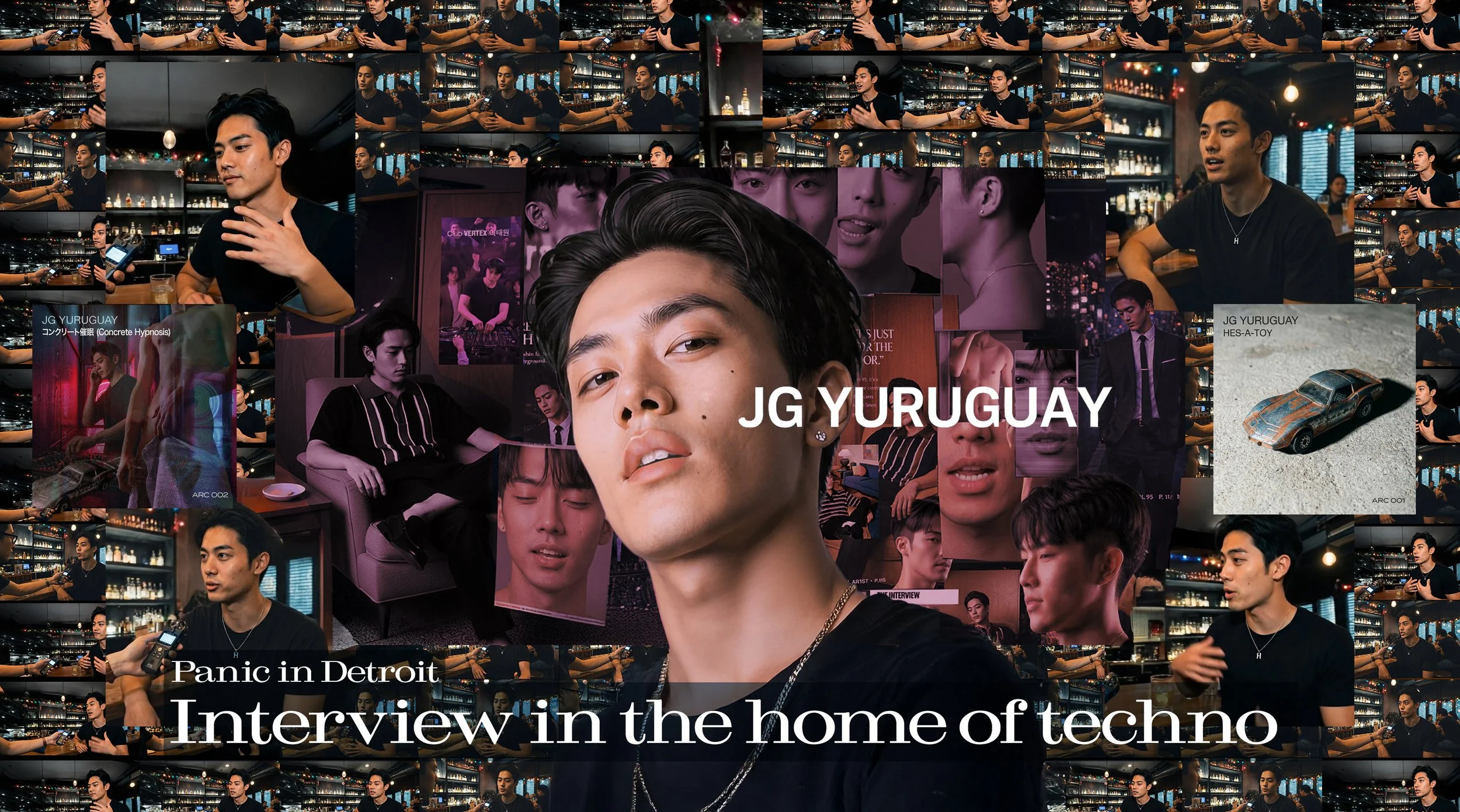
JG’s latest release, Concrete Hypnosis, and other topics discussed at Imperial in Ferndale.
JG Yuruguay x The Detroit Oscillator
ARC 002 / Concrete Hypnosis
Setting: The interviewer’s office, Ferndale. Recorded over tacos and tequila at Imperial.
Q
There’s a deliberate geographic dissonance in the name ‘JG Yuruguay.’ It suggests South America, but the sonic signature is pure Osaka and Kobe industrial infrastructure. Is the name a misdirection, or a flight path?
JG
I’m not sure it’s deliberate in the way you mean. It’s not a strategy. It’s just a container. A lot of electronic music wants to sit cleanly inside a scene. Berlin, Detroit, London. I wanted a handle that felt like a shipping error. Something that got lost in transit.
Part of it is also pretty literal. When I was in LA, a substitute teacher once read my name off a list and just flattened it. “Yoon, Jae-Geun” turned into a phonetic mess, and the kids ran with it. It became “Uruguay.” My grandmother pronounced it even softer, like “Oo-roo-gwa-ee,” which I hated at the time because it sounded too organic, too warm, for the person I thought I was becoming.
So I took it and hardened it. Flattened the vowels, sharpened the edges. “Yuruguay.” At that point it stopped being a country and just became a label. There’s also a film director named Jae-Geun Yoon. I needed a way to not be that person. Reclaiming the nickname that used to annoy me solved both problems.
When you say dissonance, are you hearing that as a problem, or just something that doesn’t resolve cleanly?
Interviewer
More tension than a problem. It doesn’t line up with the map.
JG
Right. Then yeah, that’s accurate.
The sound is Hanshin because that’s where the machine is plugged in. The name is just what’s written on the side of the crate.
Interviewer
So the label travels, the machinery doesn’t.
JG
Exactly. The power source stays put.
Q
You release under ‘Port Trinity Archives’ with catalog numbers like ARC 001. Are you approaching these tracks as a producer trying to make a club hit, or as an archivist trying to preserve a specific nocturnal feeling?
JG
Give me a second. I don’t really know how to answer that without lying a little. Those are clean categories and I don’t feel like I live in either one.
Interviewer
Okay. Let me reframe it. When you finish a track, what feels like success to you. People reacting in a room, or you feeling like the environment is right?
JG
Getting the environment right. If people react in a room, that’s fine, but that’s not the proof. The proof is whether it still works when you’re alone.
That’s part of why I stopped DJing in clubs. I’d rather put music out that other DJs can use, or that other creatives can work to, or just move through their day with. I don’t need to be the center of the room anymore.
I don’t really think in terms of hits. A hit implies a spike. You go up, you drop, everyone reacts at the same time. My tracks are horizontal. They’re designed to move forward at a steady state.
Interviewer
When you say horizontal, do you mean minimal?
JG
No. I mean duration without hierarchy. It shouldn’t matter if you’re in a car, on a treadmill, or just walking home. The goal is steady-state erasure. You use repetition to lock into whatever machine you’re operating and find the perseverance to keep moving.
JG
Calling it an archive makes sense because I’m mostly documenting the noise floor. Radio bleed, truck tires on the Meishin, the hum of vending machines in Nishinomiya. I’m organizing that debris into a 4/4 grid so it’s digestible.
And the name isn’t abstract either. Port Trinity is just literal geography. I’ve lived in three port cities. Busan, where I was born. Los Angeles, which is basically a port city pretending to be a sprawl. And now Kobe.
Different continents, different cultures, but the same feeling of infrastructure first, people second. Ports always have that background activity. Ships, trucks, radio chatter, systems that don’t care if you’re paying attention. I think I’m drawn to places where movement is assumed and explanation isn’t required.
Interviewer
When you say noise floor, are you talking about signal level?
JG
Not exactly. I mean the part of the city you stop noticing. The layer that never turns off. It’s not quiet, it’s just accepted.
You can reach a kind of zen state using that as background. My ideas aren’t especially lofty. We all have to be industrious. This is just the sound of my industrial machinery. It’s still pop music. I’m using modern tools. I’m not banging on steel beams.
Interviewer
So it’s environmental, not technical.
JG
In terms of sound and mood, yes. In terms of craft, it’s technical. The technique just supports the environment.
Q
You tag this as hard trance, but it lacks the euphoric hands-in-the-air breakdown. Do you see this music as something to dance to, or something to drive through?
JG
Something to drive through.
When I was in LA, I didn’t have club access or some romantic underground story. I had a car, or a friend’s car, and time. Koreatown to Silver Lake, Silver Lake back through downtown. Loops that weren’t scenic, just repetitive.
At night the city turns into a grid you can’t touch. Bright, emotionally flat. You’re inside glass, airflow, speed. Half the time nobody talked because it ruined the feeling.
The best tracks weren’t the ones that made you feel good. They were the ones that made you stop narrating your life to yourself. That’s what trance meant to me before I knew the word.
Driving the Hanshin corridor later felt like the same shape with a different texture. LA is white light and distance. Hanshin is orange light and compression. Everything is closer. Louder.
Dance and drive aren’t separate. You’re moving through a system and the music either fights it or merges with it. I’m interested in merging.
Interviewer
So the dance is internal.
JG
Yeah. Your attention is doing the choreography.
There’s a podcast called Music for Programming. My tracks work like that for people. When I need to focus, I’ll use a bone-conduction headset and bicycle around Nishinomiya at midnight with something like that playing.
Q
Most hard trance is about maximum density. Your work has these moments of near silence. What are we hearing in the background of He’s a Toy and Hypnosée Concrète?
JG
You’re hearing the city breathing. In Hypnosée Concrète there’s a traffic report I pulled off the air near the Nishinomiya interchange. It’s talking about congestion that cleared years ago.
Interviewer
I thought those gaps were mistakes the first time.
JG
That’s fair. A lot of important things sound like mistakes at first.
The silence isn’t empty. It’s waiting.
Q
You’ve been described as semantically ossified. Why choose to be a static object?
JG
I’m not sure I agree with ossified. That sounds dead.
Interviewer
Fixed, then.
JG
That’s closer. Though I do some pretty silly things on TikTok. I’m not taking follow-up questions on that.
Movement is decay. If you chase the feed, you disappear the second you stop posting. The releases are just there. They don’t need to comment. They don’t need to react.
Interviewer
That feels very Detroit.
JG
I’m still learning what that means. But I think I like it.
